Pharmaceutical Demand Planning: When One Size Fits None

Every quarter, pharmaceutical supply planners face an impossible choice: order too much and watch billions in drugs expire on shelves, or order too little and face emergency shortages during demand surges.
The Problem: The $40 Billion Problem
The challenge isn't forecasting demand in general. It's that every drug's demand behaves completely differently.
- Antivirals like Tamiflu: Swing 40× between winter peaks and near-zero summers. Miss the flu spike and you face emergency backlogs. Overproduce and short-shelf-life inventory expires.
- Antibiotics like Amoxicillin: No seasonal pattern. Demand moves with economic conditions nobody predicted six months ago.
- Chronic medications like Levothyroxine: Steady demand, but tie up massive inventory. Any unexpected shift means either stockouts or overstock.
Traditional forecasting requires building separate models for each drug—taking weeks or months per NDC (National Drug Code). With thousands of products to manage, most companies give up and rely on rules of thumb.
The result: Expired inventory during low seasons. Emergency shipments during surges. Production plans that whipsaw with every unexpected change.
The question: What if one model could forecast all of them, immediately, and tell you which external signals actually matter?
The Solution: Three Drugs, Three Different Stories
We pointed Symnasium agent at three national Medicaid drug-demand series (State Drug Utilization Data), forecasting 2025 quarterly demand (Q1-Q4) from 2018Q1-2024Q4 training data.
Zero per-drug tuning. Seconds to forecast.
The model had access to potential drivers: flu surveillance, RSV activity, price, unemployment, enrollment. Its job: figure out which signals matter for which drugs.
What we compared it to
Opus 4.8 Ultra Code tasked with building a forecasting model.
Here's what happened.
Story #1: Oseltamivir (Tamiflu) — The Flu-Driven Surge
The Challenge:
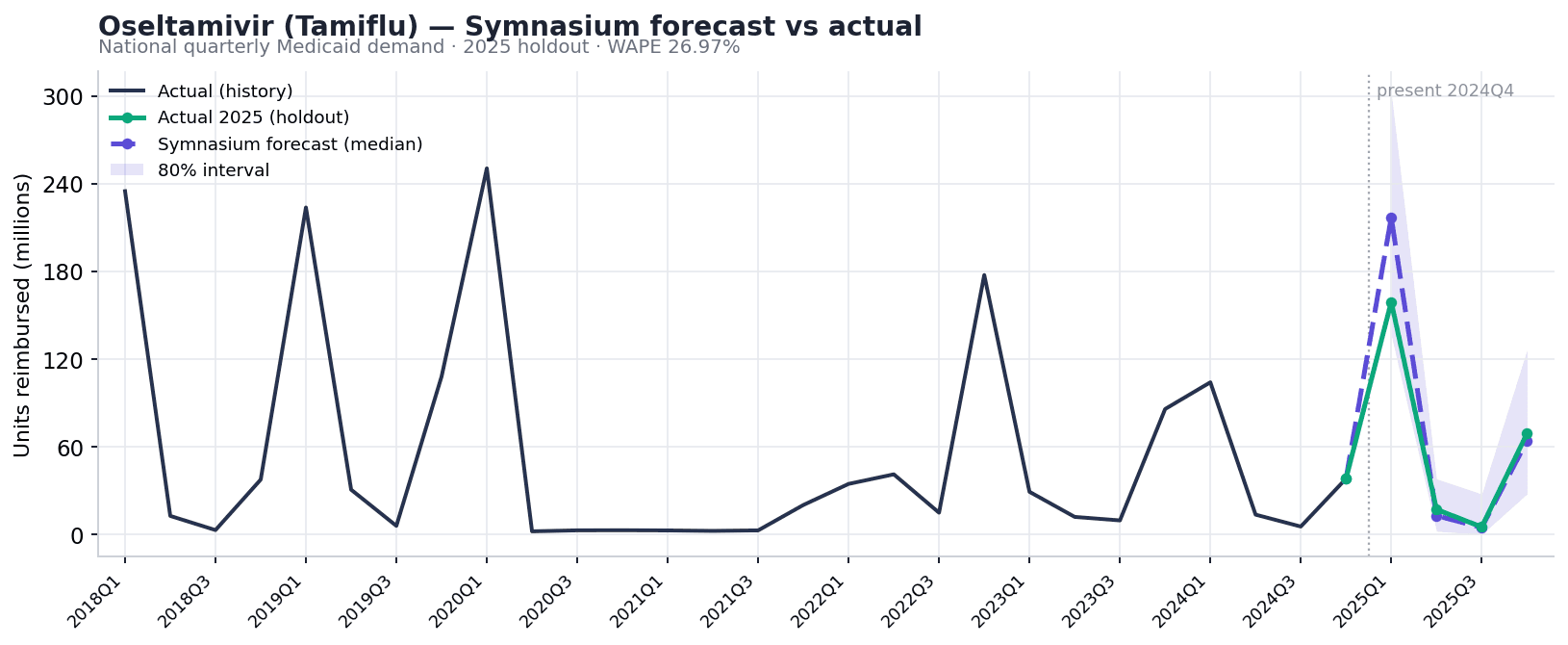
Tamiflu demand is a rollercoaster. Winter flu season brings 40× spikes. By summer, demand approaches zero.
Traditional approach: Cold forecast (no external data) gave 65.94% WAPE—essentially guessing.
The Discovery:
The model tested combinations and found: price + unemployment + enrollment.
The Results:
26.97% WAPE (MASE 0.393) with flu data
−59% error reduction from baseline
Flu correlation: r = +0.92 — the strongest driver in the entire study
ΔR² = +0.236 — largest predictive gain of any covariate tested
But here's the key finding: Adding ANY other covariate made it worse.
The model tested price, unemployment, enrollment, RSV—and actively rejected all of them. Flu surveillance alone is the signal. Everything else is noise.
What This Means:
Stop paying for data you don't need. The agent proved that flu surveillance is the ONLY driver worth buying for antiviral forecasting. Don't waste budget on macro data feeds that actively hurt performance.
Tie production directly to flu activity. When flu surveillance shows 0.92 correlation with demand, that's your leading indicator. Forecast the surge before it hits.
Story #2: Amoxicillin — The Macro-Driven Antibiotic
The Challenge:
Amoxicillin isn't seasonal. It doesn't follow flu patterns. So what drives it?
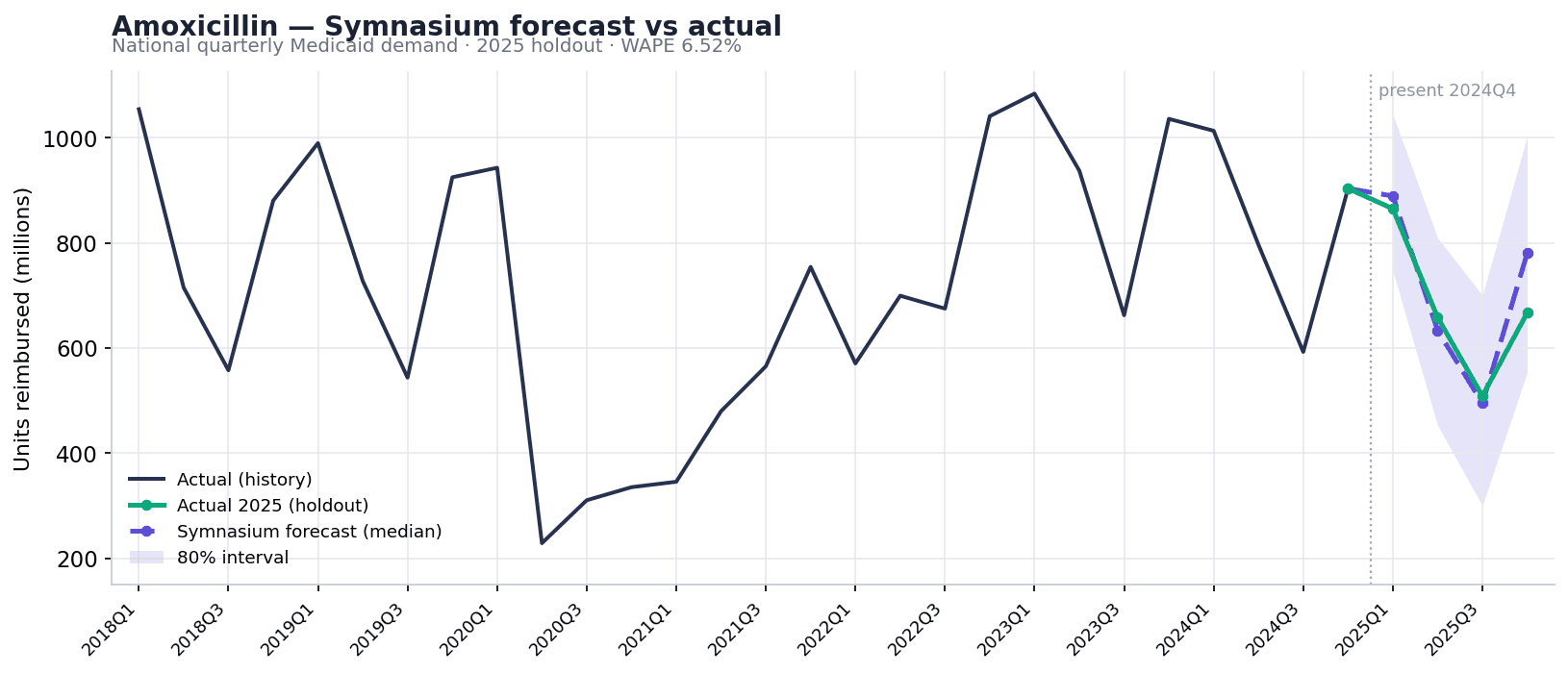
Traditional approach: Cold forecast gave 14.08% WAPE—better than Tamiflu baseline, but still leaving significant error on the table.
The Discovery:
The model tested combinations and found: price + unemployment + enrollment.
The Results:
6.52% WAPE (MASE 0.209)
−54% error reduction from baseline
Flu and RSV were rejected — the exact opposite of their role for Tamiflu
This proves per-drug driver discovery matters. What moves one drug doesn't move another.
What This Means:
Antibiotic demand follows economics, not disease surveillance. Plan production batches based on macro indicators. The model figured out which ones mattered—automatically—in seconds.
Different drugs need different signals. You can't use the same forecasting approach for your entire catalog. The agent ran the test for each drug and told you which drivers to use.
Story #3: Levothyroxine — The "Boring" Drug That Caught an Anomaly
The Challenge:
Levothyroxine is a chronic thyroid medication. Demand is steady, predictable. Most forecasters set it to historical average and move on.
The Discovery:
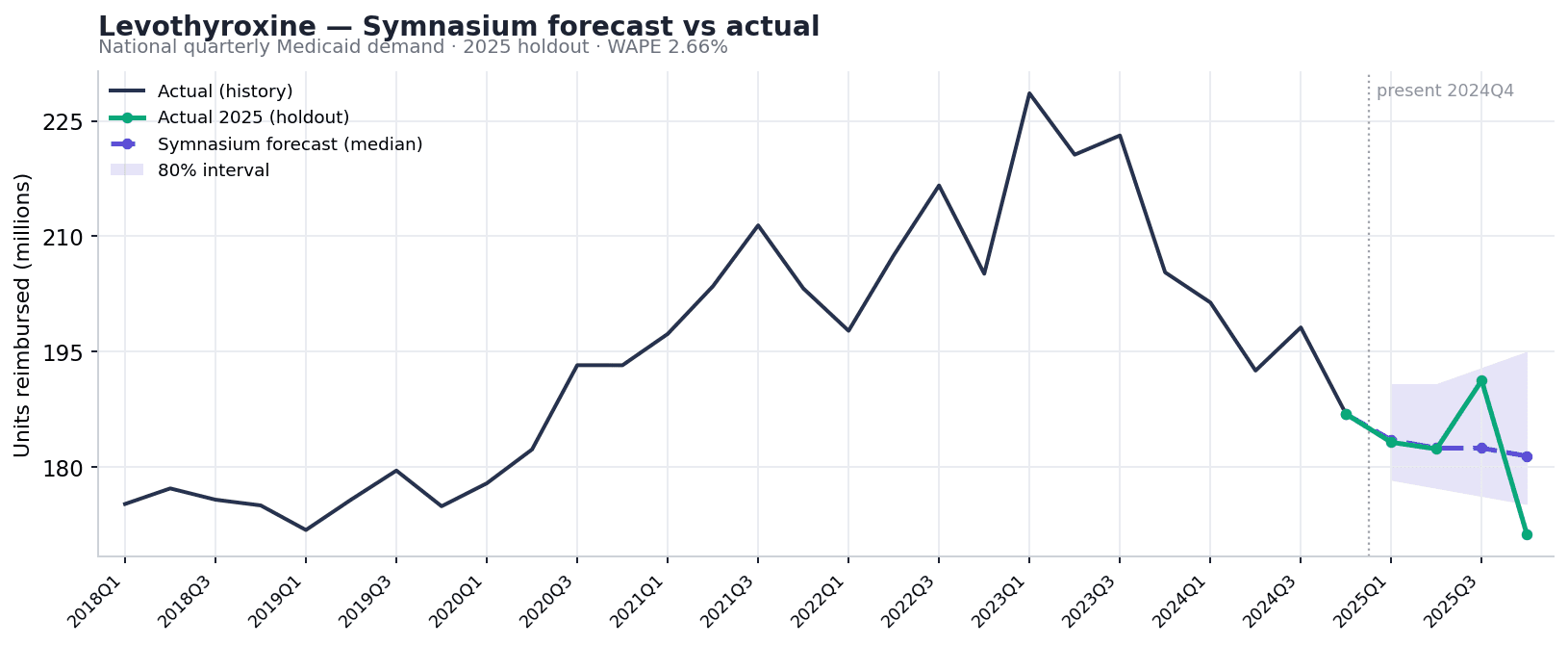
Symnasium agent delivered 2.66% WAPE (MASE 0.411) with zero tuning—near the noise floor. Essentially covariate-independent (external signals don't help).
But here's the twist: The model's calibrated bands caught a genuine out-of-90%-band event in 2025Q4 that wider Opus 4.8 intervals missed entirely.
What This Means:
Even "boring" steady-state drugs benefit from foundation models. The tight, honest uncertainty bands give early warnings when something genuinely unusual happens—policy changes, supply disruptions, unexpected demand shifts.
Opus 4.8's loose bands absorb these as noise. You miss the signal.
Story #4: What the Symnasium agent can do and coding agents cannot.
The Challenge:
In 2010-11, Florida cracked down on "pill mills." Almost overnight, opioid shipments dropped as enforcement ramped up.
This is the nightmare scenario: A policy-driven regime shift that breaks every forecast model built on pre-crisis data.
The Test :
We tested Symnasium agent on monthly US opioid shipments (DEA ARCOS dataset, 2006-2014):
- Florida — carries the 2010-11 pill-mill crackdown (the hard case)
- US National — smooth seasonal reference (no regime shift)
The model had access to trends, days in month, unemployment, population—but no special treatment for the changepoint. It had to figure it out.
What we compared it to: Opus 4.8 Ultra Code tasked with building a forecasting model. Our baseline is whatever forecaster Opus 4.8 Ultra Code converges on—for these series, SARIMAX.
The Results:
Florida (with regime shift):
Symnasium agent: 0.0364 WAPE
Opus 4.8: 0.0502 WAPE
−27% relative win
But the real story is robustness. When we look at both models with no covariates:
Opus 4.8: 0.2013 WAPE — over-extrapolated the pre-2011 decline
Symnasium agent: 0.0422 WAPE — tracked the 2013-14 plateau
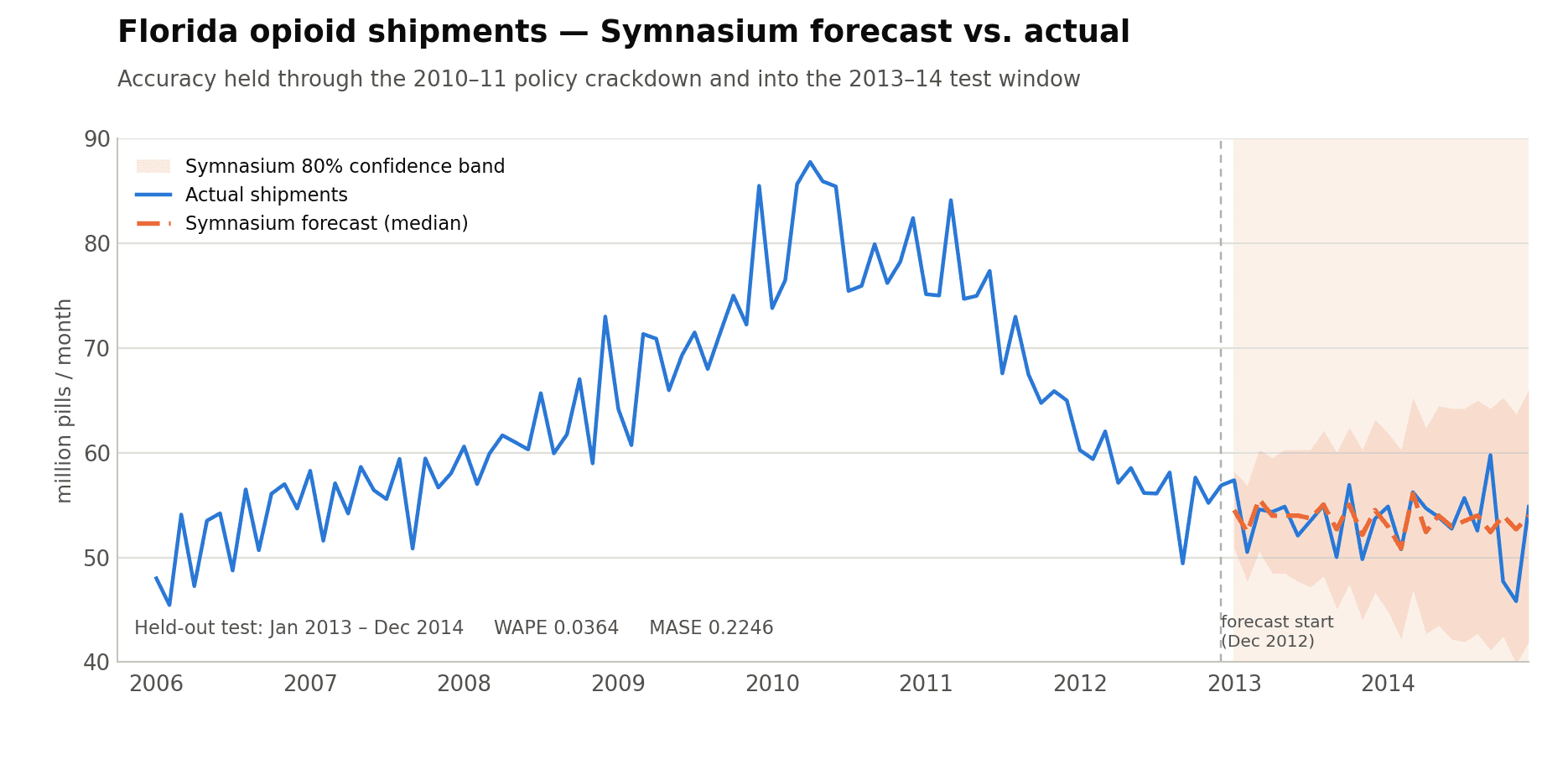
Why? Opus 4.8 bakes in momentum assumptions into the SARIMAX model that it decided to implement. Foundation models don't. When the trend breaks, the Symnasium agent adapts. Opus 4.8 keeps extrapolating into the void.
The changepoint discovery: The agent cleanly surfaced the changepoint at 2011-04 —the exact mechanism that broke the Opus 4.8 model.
Result: Symnasium agent was ~5× more accurate across the changepoint.
The Tagline: Symnasium Agent Wins on all 3 stores
Antiviral (Oseltamivir): 26.97% WAPE, MASE 0.393 — −59% error vs baseline, flu surveillance alone (r = +0.92)
Antibiotic (Amoxicillin): 6.52% WAPE, MASE 0.209 — −54% error vs baseline, price + unemployment + enrollment
Chronic (Levothyroxine): 2.66% WAPE, MASE 0.411 — near the noise floor, caught a 2025Q4 anomaly wider bands missed
It took seconds instead of weeks-per-NDC model-building cycles.
Regime-shift robustness: Across the 2010-11 Florida opioid crackdown, the agent held to 0.0364 WAPE — ~5× more robust than Opus 4.8 when frozen at zero-shot.
Summary
| Metric | Result |
|---|---|
| Oseltamivir (antiviral) | 26.97% WAPE, −59% error vs baseline, flu alone (r=+0.92) |
| Amoxicillin (antibiotic) | 6.52% WAPE, −54% error vs baseline, price+unemployment+enrollment |
| Levothyroxine (chronic) | 2.66% WAPE, caught 2025Q4 anomaly, covariate-independent |
| Florida opioids (regime shift) | 0.0364 WAPE, −27% vs Opus 4.8, ~5× more robust |
| US opioids (smooth) | 0.0360 WAPE, −5% vs Opus 4.8 |
| Time to deploy | Seconds (zero per-drug training) |
| Leakage caught | txn_count rejected (r=0.94 but ΔR²=−1.3) |
| Driver rejection | Flu rejected for amoxicillin, price rejected for Tamiflu |
| Cold-start capability | Day-one forecasts for new NDCs |
The Platform Value: Automated Driver Discovery
Symnasium transforms forecasting from a guessing game into a precise strategic instrument by automatically isolating the unique DNA of demand for every product in your catalog.
Precision Optimization for Volatile Demand:
For high-variance antivirals like Oseltamivir, the agent eliminates the "noise" of macro-economic data and secondary disease markers. By pinpointing flu surveillance as the sole high-impact driver, Symnasium allows planners to eliminate wasteful spending on irrelevant data feeds while providing the surgical precision needed to prevent billions in inventory expiration.
Intelligence Shifts for Non-Seasonal Portfolios:
The platform proves that generalized forecasting models are a liability. For Amoxicillin, the agent automatically rejected the disease patterns that governed other drugs, shifting instead to specific economic intelligence—price, unemployment, and enrollment. This ensures that distinct drugs are managed with distinct intelligence, preventing the “one-size-fits-all” errors that lead to emergency stockouts.
Advanced Early-Warning Systems:
Even steady-state medications like Levothyroxine benefit from a more rigorous standard. Symnasium reframes "boring" demand by applying tight, honest uncertainty bands that act as a sensitive early-warning system. While broader models like Opus 4.8 absorb shifts as mere noise, Symnasium's precision detects genuine anomalies, alerting leadership to policy changes or supply disruptions the moment they begin to emerge.
What this means:
Trust here isn’t a promise that the model is right. It’s the receipt that proves which model is right, for which store, with which inputs, and by exactly how much.
How does Symnasium help you improve your operations and your bottom line
Antiviral Stockpiling
Flu season brings 40× demand spikes for drugs like Tamiflu.
- What we measured: 59% error reduction using flu surveillance (65.94% → 26.97% WAPE)
- What this means: Tie production directly to flu activity (r = +0.92). Stop emergency shipments and expired inventory waste.
Production Planning: Antibiotics
Antibiotics follow economics, not disease patterns.
- What we measured: 54% error reduction using price + unemployment + enrollment (14.08% → 6.52% WAPE)
- What this means: Plan batches based on macro conditions. Reduce write-offs from expired stock.
Safety Stock Optimization: Chronic Medications
Even steady demand needs monitoring.
- What we measured: 2.66% WAPE (near perfect). Caught out-of-90%-band event in 2025Q4
- What this means: Right-size inventory with tight confidence bands. Get early warnings when demand shifts unexpectedly.
Regulatory Surveillance: Opioids
When policy changes, Opus 4.8’s forecasts break.
- What we measured: 27% better accuracy across regime shift. 5× more robust when frozen
- What this means: Supply plans that don't whipsaw with regulations. Auditable bands for suspicious-order monitoring.
- Governance value: Documented record showing why leaky feeds (txn_count) were rejected before production
Driver Discovery: Know What NOT to Pay For
Data vendors promise better forecasts. Which signals actually help?
- What we measured: Flu cut Tamiflu error 59%. Same flu data hurt amoxicillin (rejected automatically)
- What this means: Per-drug testing. Only pay for feeds that improve YOUR specific forecasts (proven, not promised).
Get Started
Ready to see what Symnasium can do with your pharmaceutical data—or any time-series forecasting challenge?
Try Symnasium Free
Import your data and benchmark models before any commitment
Review Reference Builds
See complete methodology for MLB, pharma, retail, and energy
Custom Evaluation
Run a held-out backtest on your own data